
As a child, I would
often spend weekends in Girardville, PA. That's where my dad is from.
It's a relatively small town, home to less than 2,000 people. Even at
a young age, I was struck by how depressing the place was. The coal
mines that once sustained the town financially had since long dried
up. I don't ever remember seeing a single child in all my time spent
there. It was like everything that still had any vitality to it had
long since moved away or was swallowed whole by the crippling stasis
of a town that never recovered from its economic collapse.
There
were churches, of course, and plenty of bars populated by old men
that all looked like they had been stubbornly refusing the grave for
decades. People spoke about pre-Vietnam times like they were
yesterday. No one seemed concerned or even interested in tomorrows or
todays. Just the old times, the better times. Every conversation was
about people in the past or long evenings spent in the 50s or 60s,
and nary an hour went by without someone telling me that I reminded
them of so-and-so when they were little. Visiting that old town was
like wandering into some great wake full of people endlessly
mourning the death of the "good old days".
That is the kind of
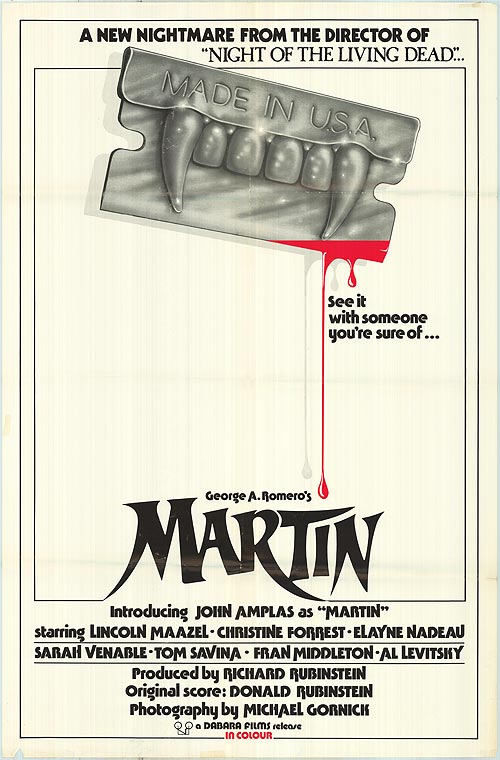
setting that George Romero's MARTIN takes place in. The town is
Braddock, just outside of Pittsburgh. The town is old and dying. It's
the kind of place where two cousins, one female and one male, living
beneath the same roof is considered inappropriate. Masses are still
partially delivered in Latin and the old priest still performs
exorcisms, much to the chagrin of the new priest in town, a younger
man who smokes and chuckles about seeing THE EXORCIST at the theater.
The depressed state of the economy is driving the younger citizens
out to the city. Every housewife we meet is either being cheated on
or is cheating on her husband. Everything is decaying. People talk about the older days and the older ways, as if they were more pure and noble. It's like no one ever thought about whether or not they should move on and leave the past in the past.
Into this
environment comes Martin, a young man in his early 20s. He has
freshly arrived from some undisclosed place to stay with his elderly
cousin, a man named Cuda. Martin is reclusive, almost cripplingly
shy, but soft spoken and gentle. He's also a vampire. Or so he
believe himself to be. The sun only bothers his eyes a little and
religious icons hold no power over him. “I'm 84 years old”, he
tells his cousin Christina, a 20-something woman looking to get the
hell out of Braddock before it poisons her too.
Cuda also believes
that Martin is a vampire. In fact, Martin has been sent to live with him
for a reason. Cuda is to cleanse Martin's soul before eradicating
him. To protect himself and Christina, Cuda hangs garlic on the
doors, carries a crucifix and even rigs a bell system on the
door so he knows when Martin comes and goes. For Cuda, the Nosferatu
is a real thing, a demonic curse put upon his family. The evidence of
that curse is kept in a family photo book and through the hushed
legends the family pass down from generation to generation. “There
is no magic”, Martin tells him, but for Cuda, the magic is all too
real. Martin is a vampire and is to be destroyed if he so much as
harms a hair on any person living in the city.
MARTIN is a complex
bit of work, far more nuanced that your typical run of the mill
vampire film. The world of the characters is an explicitly Catholic
world (Romero himself grew up in a Catholic family) and perhaps this
is just my atheism coloring my perspective, but the underlying point
of the film seems to be that there is an inherent danger in adopting
a Bronze Age system of beliefs.
Cuda belongs to the backwards
intellectual class of people that once thought the way to solve
tremors was by drilling a hole through the skull to allow the demons
shaking the body to escape. He gives holy importance to plastic
crosses and cloves of garlic. When Martin decides to give Cuda a
little fright by dressing up like your typical movie vampire,
complete with a cape and plastic fangs, Cuda doesn't respond with a
frown and a groan of displeasure. He responds by collapsing in fear,
dangling his rosary in front of him. His “old country” beliefs,
rife with supernaturalism, have robbed him of the ability to know
fantasy from reality. Martin may not be a monster in the literal
sense of the word, but Cuda, his head pumped full of religious
delusion, definitely makes him out to be.
Martin is both a
victim and a victimizer. The film alludes to his upbringing being one
of near constant brainwashing. He's been told that he's a vampire
presumably since birth. Throughout the film, Martin suffers from
delusions (presented to us in glorious black and white vignettes),
exhibits signs of extreme gaslighting and routinely displays
ambivalence towards anyone expressing doubts about his condition. “It
isn't magic. It's a sickness”, he tells Cuda and right he is. In
the underlying allegory of the film, Martin's vampirism, that is his
inherent sinfulness, is a sickness, one that Catholicism claims we
are all suffering from. We are all the inheritors of original sin,
disgusting creatures in need of salvation, damned since birth.
The Catholic
preoccupation with all things carnal is depicted here as scenes of
vampirism (vampirism has always had a sexual component, after all).
Martin, kept by his family in a state of repressed, almost infantile
sexuality, can't even bring himself to refer to the act as “sex”,
instead referring to it in a juvenile way as “sexy time”. His
acts of vampirism are brought on by sexual longing, preferring to
only attack attractive women. He drugs them and rapes them, ending
the encounter by slitting their wrists with a razor blade, drinking
their blood. He poses the bodies, giving the impression that the
victims committed suicide (another Catholic preoccupation).
Because
of his upbringing, Martin only recognizes sex as something sinful,
something that ends in catastrophe. When he finally meets Mrs.
Santini, a bored, lonely housewife and has sex with her, razor blade
free, it pacifies him. The sequences between the two are the only
time we see Martin engage in what can be considered normal, healthy
behavior. But because this is a horror film and the allegory cannot
end in anything but total destruction, the happiness (or at least
relative passivity) doesn't last long. Martin cannot completely
overcome his delusions and Cuda, ever sure that Martin is little
more than a mythical monster, misconstrues a simple tragedy as
something unholy.
In the end, everyone
suffers, all because of religious delusions. The film is a parade of
wasted and ruined lives, and if that sounds like a downer to you,
well, it is. MARTIN is not DAWN OF THE DEAD. It isn't a Saturday
morning cartoon. This is a tragedy wrapped in a horror film. But it's
also a breathtaking bit of work, a supremely fascinating
deconstruction of the vampire film, written and directed by a true
independent filmmaker at the height of his creative potential. It's
my favorite of all Romero's films and at the risk of sounding like
I'm heaping false praise, this is one of those films that offers me
up something new each time I watch it. It's assured enough in its own
message that it never feels the need to hold my hand throughout. It's
subversive enough to be both hilarious and uncomfortable, often at
the same time. It's existential as well as being delightfully morbid,
capable of tickling both the brain and the gag reflex.
It's also a film
that can be watched and enjoyed from multiple angles, which makes it
a perfect film to argue about on the internet. And who doesn't love
to argue about movies on the internet?
