Showing posts with label slasher. Show all posts

July 26, 2018

DEMON WARRIOR

Through a clumsy exposition scene we learn that the old Willard property used to belong to some Native Americans. Old man Willard stole the property from it’s rightful owners and the Native Americans, none too happy about that fact, placed a curse on the land. Every ten years, for an unspecified amount of time, an ancient muscle-bound man in a monster mask materializes in the woods, hunting and killing any white man or woman he comes across.

A gaggle of college aged whities are about to have a really bad weekend as their hunting trip turns into an implied bloodbath, 90% of which happens during the daytime hours. Will Neal, the youngest member of the Willard family to ever return to the old family lands, be able to stop the marauding Demon Warrior before he can kill his lovely girlfriend, Sarah, and his friends Brent, Hassmiller and… sigh… a guy named Badger? Neal might be in luck, as an investment banker turned Indian shaman has arrived on the scene with a magic arrowhead, ready to do battle with the buff guy in the monster mask.

So yeah, Frank Patterson’s 1988 low budget slasher movie DEMON WARRIOR is yet another Native American themed horror film, just another romp about some well-to-do white people paying bloody reparations for the sins of their fathers. It seems this kind of film pops up from time to time. POLTERGEIST featured the typical Indian Burial Ground trope, a nicely done and lovingly cynical look at the underbelly of white suburban life. Tobe Hooper’s (or Steven Spielberg’s) film sits at the top of the list, a genuinely good large scale horror film. Much, MUCH further down the list you have tripe like Fred Olen Ray’s SCALPS and George McCowan’s SHADOW OF THE HAWK, and somewhere in the middle, there’s some fairly decent stuff, like William Girdler’s gonzo sci-fi/horror mash-up THE MANITOU and the Wendigo cycle of horror films from Larry Fessenden.

Where does DEMON WARRIOR fall on the list? Pretty low, to be honest. This is a film where virtually every detail of the script seemed to be dictated by the incredibly low budget. Although our cast of characters are all crashing at Neal’s family home, we spend very little time there, most likely because the production could only afford the location for a single day and the owners didn’t want their nice hardwood floors stained red with food coloring. As a result, the vast majority of the film takes place outdoors, but not in the woods or near any kind of eye catching scenery. Expect a lot of walking and running through wide open fields with characters simply crossing through the frame because no one could afford a Steadicam or any other kind of camera-stabilizing mount.

90% of the film happens during daytime hours, a good choice if you’re looking to save a few hundred bucks on lights and generators, but definitely not a good choice if you’re trying to create atmosphere or scares. The demon warrior is wisely kept off screen in these daytime scenes, only showing his poorly constructed face during the nighttime scenes that bookend the film. He’s a ridiculous creation, literally just an oiled up bodybuilder in a Halloween mask. He doesn’t even get a roar or a growl. He just shoots arrows and moves at a light jog so the actor in the oversized mask won’t trip on a log or a rock.

The only saving grace in DEMON WARRIOR is the cast of characters, many of whom actually have personalities, wants and needs, and emotions that go beyond the typical “must get laid” attitudes of 1980s slasher movie characters. There’s a bit of a love triangle between Neal, Sarah and Brent, her old boyfriend who still carries a flame for her. Patterson and his co-writers actually treat this element of the script with a lot of care. When Hassmiller calls Brent out for trying to hit on Neal’s girlfriend, Brent rightfully points out that Hassmiller is currently sleeping with, you guessed it, a woman in a relationship. This leads the two men to have a somewhat heartfelt ethical conversation about relationships and love and… I don’t know. It’s not poetry, but the fact that a film called DEMON WARRIOR has the audacity to stop in it’s tracks so two of it’s male characters can have a kind of heart-to-heart about their love pangs is, well, kinda neat.

Not that anything really comes of it, as Hassmiller’s love interest exits the narrative as quick as she enters it and Brent is shot with an arrow before he settles on a course of action, but it’s the thought that counts, right? I mean, no one in the cast is a world class actor and all the characterization is in service of a plot about a shirtless man in a Halloween mask chasing people through a field for 26 minutes, but I have to say that in a world full of obnoxious, can’t-wait-for-them-to-die slasher movie characters, the knuckleheads on display here are actually really likable.

Unfortunately, everything else about DEMON WARRIOR is not so likable. All of violence (minus a few arrows to the chest and a nice, juicy scalping) is off screen, the Final Girl never gets to be a proper Final Girl, and the whole film boils down to a long scene of Indian magic and unconvincing lightning optical effects. There just isn’t a lot of movie here. Most of it is running through fields and making sandwiches. There is however a rather ludicrous car accident and at least one memorable nightmare sequence. So it’s not totally useless, I guess. It’s just not very good.

June 13, 2018

DEADLY DREAMS

As a young boy, Alex witnessed his parents being gunned down on Christmas Eve by an angry ex-business associate in hunting gear and a wolf mask. Now a young man in his late teens, Alex is an aspiring writer attending a local college. Haunted by recurring nightmares of the long dead, mask-wearing killer, Mr. Perkins, Alex’s life is in a bit of a shambles. Even his new relationship with a gorgeous young dancer named Maggie isn’t enough to set his mind at ease. As Alex’s nightmares worsen, his dream life begins spilling over into his waking life. He begins seeing Perkins skulking around his home at night.

His ability to tell fantasy from reality at an all time low, Alex begins to suspect that someone is out to kill him – or to drive him insane. Is it his slightly sadistic, pill popping best friend Danny? Or maybe it’s his older brother, a man desperate for his Alex to pour his considerable inheritance into the sinking family business? Or maybe Maggie is behind all of this? Or maybe, just maybe, Perkins has returned from the grave to finish what he started all those years ago…

At a brisk 79 minutes, Kristine Peterson’s 1988 directorial debut DEADLY DREAMS dances effortlessly back and forth between rubber reality psychological thriller and mean spirited slasher. It’s a clever film, one that could have been a real contender had it been gifted with a little more production money and proper distribution. The film might not be perfect (the interior design choices, especially Alex’s completely blue apartment, are oftentimes ghastly, and the decision to stage a steamy sex scene on a rotating bed was just… no), but DEADLY DREAMS is honestly one of the better unheard of horror movies from the 1980s, nowhere near a classic, but most definitely a cut above most cheaply made cookie cutter genre efforts.

The way Peterson handles the frequent collapse into nightmare logic is more akin to Luis Bunuel than Salvador Dali. While Dali wrapped his surrealism up in abstract symbology, Bunuel filmed his dreams, nightmares and surreal flourishes in the same purposefully detached manner that he filmed everything else. A shot of ants pouring from a hole in a hand is as matter-of-factly presented as a shot of uptight jerks standing around a dinner table. In DEADLY DREAMS, there is no clear cut delineation between nightmare and waking life, no sudden transitions in the color palette from blues and yellows to baby shit brown and puke green. No slow motion or Dutch angles. No odd shifts in the sound design.

This helps Peterson firmly align the audience with Alex’s cracking psyche. Dreams within dreams, dreams which seem to portend future events, dreams which seem to be occurring within reality… this is all blended into the film rather well, so well in fact that early on I expected the final twist of the film to simply be “Alex really is insane. The end”. What we get instead is a kind of twist within a twist that strongly parallels many early giallo films, especially the Umberto Lenzi gialli of the late 1960s and early 1970s, many starring Carroll Baker.

It isn’t really a spoiler to say that someone is indeed after Alex’s inheritance and is using his post traumatic stress against him in an attempt to drive him crazy. That will undoubtedly be evident by the 30 minute mark. It’s everything that comes after the pronouncement of motive that took me by surprise. Like Lenzi’s PARANOIA, the film doesn’t hesitate to follow through on its premise. It also doesn’t feel the need to call it quits after revealing the double cross, instead using that bit of narrative development to propel itself towards a rather stunning (though a bit daft) triple cross that sends the film out on a spectacular high note.

The blend of psychological thriller and slasher film works well for most of the film, though if you’re looking for a body count, you should most definitely look elsewhere. Most of the murders are revealed to be nightmares and many times the victim in those murder set pieces is Alex. His parent’s deaths are replayed three or four times from various angles and one unexpected death occurs completely off screen. In other words, instead of watching multiple people die, you’re really only watching two or three people die, usually over and over again. That isn’t to say that the film lacks teeth. Some of the nightmare death scenes are in fact pretty jarring, especially one involving a knife to the face.

But DEADLY DREAMS doesn’t want to be a body count film. It’s a psychological thriller through and through, one with a small cast of well defined characters and a tightly crafted, intimate story full of reversals, betrayals and lies. It’s a well acted and well executed little film, one that definitely deserves rediscovery and reappraisal.

June 8, 2018

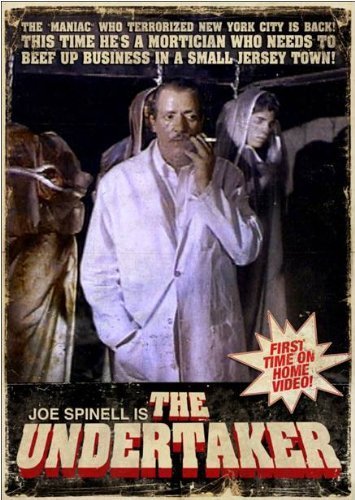
THE UNDERTAKER

Calling THE UNDERTAKER an oddity is a bit of an understatement. All but abandoned when the production ran out of money and lead actor Joe Spinell kicked the bucket, this low rent slasher film (with no fewer than four directors, here credited under the collective pseudonym Franco Steffanino) first hit DVD a few years back, only to be later reissued on Blu-ray by the venerable cult maniacs at Vinegar Syndrome. The Code Red DVD was my first experience with the film and I was dumbfounded by how much footage from other B-movies was incorporated into the proceedings to fill dead air (in particular, footage from Wallace Fox’s 1942 schlocker THE CORPSE VANISHES appears again and again). Watching the Vinegar Syndrome release was like watching an entirely different movie, albeit one with abrupt and sudden shifts to VHS quality inserts, a compromise needed to present THE UNDERTAKER in a somewhat complete form.

The movie issued on Code Red DVD barely made any sense. It was haphazardly constructed, sliding into absurdity at the drop of a hat. Whole scenes appeared to have been out of place or improperly positioned in the edit. Watching the Vinegar Syndrome release definitely helped smooth over the rougher edges, but those lapses of logic and strange tonal shifts persisted. This was of course because the film had never been finished and while all of the major set pieces seemed to be in place, it was clear that the interstitial stuff – the transitions, establishing shots, inserts of people entering or leaving rooms – was simply never filmed or was lost to time.

As such, we have a movie where our lead villain, the necrophiliac undertaker Roscoe, has a brief dialogue exchange with a comely co-ed in broad daylight. A single cut later and he is standing outside of a woman’s house in the middle of the night. As Roscoe spies on the shapely lass cooking a hamburger in a frying pan, we cut again. We’re now standing inside the kitchen and Roscoe has mysteriously teleported inside with us. There are dozens and dozens of these moments in the film, noticeable gaffs in which characters seemingly teleport around locations or magically summon implements of bodily destruction from the ether.

The real question to ask is does any of this detract from the experience of watching a movie as goddamn bizarre as this? More on that in a moment. For right now, it’s best to summarize what passes for a plot.

Roscoe runs the local morgue. He’s also a necrophiliac serial killer responsible for a sizable amount of disappearances over the past few months. Roscoe has a nephew named Nick and recently, Nick has become suspicious of his uncle’s behavior. In a strange twist of movie fate, his anthropology professor, Pam Hayes, is currently teaching her class all about cultural traditions of necrophilia. Instead of going to the police, Nick partners up with his teacher to investigate Roscoe’s after hours activities. When Roscoe catches Nick snooping around, he quickly dispatches his nephew and sets his sights on Pam.

While all of this is going on, Roscoe attends horror movie showings, the local cops poke around crime scenes and discuss how there was “traces of semen on the intestinal tissue” of a victim (their words, not mine), a security guard with delusions of grandeur goes about solving the case himself, and an old man out for a jog pratfalls into a puddle of bloody muck.

So yeah, this movie is kind of a mess. Spinell’s performance is all over the place, giving us half-maniacal serial killer and half… well, plain old MANIAC. Sometimes, he likes to babble to the corpses he has hanging from meat hooks in the basement. In these moments, he’s essentially portraying Frank Zito in a lab coat. At other times, he’s playing something akin to a mad scientist, often talking about his laboratory as if he’s engaging in science of the ‘gone amok’ variety. It’s not difficult to guess on which shooting days Spinell showed up drunk. His performance, always the strongest suit of any horror film he appeared in, is so erratic and undisciplined here that you might think this film had four goddamn directors all of whom seemed to want to make a different film.

And that’s exactly what appears to be the case here. The film vacillates wildly between softcore porn (virtually every actress is unclothed at some point), graphic gore film, police procedural and run of the mill killer thriller. You can kind of see individual threads begin to appear. Roscoe states that the damn Surgeon General and popular diet fads are eating into his business. Maybe this was going to be a black comedy at some point before it was deemed necessary to have Joe Spinell rape the corpse of a woman he just stabbed to death? Nick’s rather early departure seems like a nod to PSYCHO. The cops actually do cop stuff here, unlike your usual low budget horror film. When Roscoe takes in a nice Satanic horror film at the local theater, we’re not given any indication that the Satanic ritual we’re watching is not actually happening in the film, a little scene that leads me to believe that someone in the crew of directors had at least one meta bone in their body. What exactly was this movie supposed to be?

I have absolutely no clue, but what I can say is that watching THE UNDERTAKER unravel was far less painful than I expected. Because there is no single guiding vision behind it, the film feels positively schizophrenic. The missing bits of interstitial stuff gives it a slipshod grasp on reality. It’s sometimes even difficult to know when one day ends and another day begins in this film. It’s a stream of consciousness feel, an accidental bit of art house wankery that just adds to the overall strangeness of the proceedings.

The kills are bloody and mean, the acting is just the right shade of excruciating, and the abundant female flesh caked the whole thing in lovely, lovely grime. It’s an ugly film and a borderline mad experiment, one that would have probably been ruined had filming reached completion. Because the absurdity of it, the ‘work in progress’ feel, is what make this otherwise mundane “been there, done that” two cent shocker into a genuine curiosity.

... ... ... ... ... ... ... ... ... ... ... ... ...

*** You can grab a copy of THE UNDERTAKER from Vinegar Syndrome HERE.
I was not provided a copy for review. I bought it with my own damn money, but Vinegar Syndrome deserves support and links help with search results. So fuck it, there's a link. ***

April 26, 2018

THE UNSEEN

Future FRIDAY THE 13TH, PART V: A NEW BEGINNING director Danny Steinmann’s 1980 pseudo-slasher THE UNSEEN begins in grand Hitchcockian style. Borrowing a page from REAR WINDOW, Steinmann begins his film with nothing more than pictures and set dressing. We see a photograph of a beautiful woman (that would be Jennifer, played by the always exquisite Barbara Bach). It’s a professional photograph, the kind that would be used in print ads. We see shelves lined with sports trophies. A few shots later, we see a man’s leg, a large scar on his knee. The man’s name is Tony. Jennifer appears in the room, in her hands is a large overnight bag. She storms out, leaving Tony to meander around the room alone. This relationship is clearly on the rocks.

Jennifer meets with her two friends, camerawoman Karen and Vicki, her little sister. The three women head to Solvang, a Danish community in Southern California (and yes, it is apparently a real place) to film a news feature on the town’s annual Danish parade. Jennifer is a news reporter and damn glad to be taking this trip. She needs to rethink her relationship with Tony, a professional football player sidelined (perhaps forever) with a bad knee injury. She’s also pregnant and wanting an abortion.

After arriving in Solvang, the gals discover their hotel reservations have gone missing. With no place to stay, they hit up another local hotel hoping to book a room. Alas, this old hotel is no longer a hotel, but a living history museum. They meet the owner, a meek and lightly strange man named Ernest. Just before the girls leave, Ernest decides to make them a friendly offer. They can stay with him at his home. Because this is a horror movie, the girls immediately accept the offer.

Upon arriving, they meet Ernest’s perpetually distraught wife, Virginia, and settle into their rooms. Vicki is tired and in need of a bath so she hangs back while Jennifer and Karen hit the town to get some footage of the parade. As she lounges in the tub, Ernest spies on her through a keyhole. Vicki’s day goes from bad to worse when she is dragged into a heating vent by someone – or something – with obvious anger management issues.

So far, so fine. It’s your standard horror set-up. Young, lovely lasses accept an offer of shelter from a kindly stranger only to meet sticky ends at the hands of a maniacal family. But something is definitely off here. First, the setting is clearly quite strange, set up in a way to simulate the typical ‘fish out of water’ horror trope without ever having to spend the dough on stock footage of a plane landing and maybe a few foreign sounding street signs to sell the illusion that we’re no longer in Kansas anymore. I'll freely admit, going for a California Danish town instead of simply pretending to be in an actual Danish town is ballsy and unexpected, but let's not mince words. A backwoods community would have sufficed. But that's only the tip of the strange iceberg that is THE UNSEEN.

What kind of news crew sends two women, one with a 16mm camera and the other with a microphone that’s very clearly not plugged into anything, to film a news report? That seems a bit odd. And if Solvang is a few hours car ride from home, why do these women even need a hotel room in the first place? Couldn’t they just drive home? Why do we cut to Virginia graphically decapitating a live chicken or to a shot of a cat licking a shoe? Is it just to accentuate the weirdness of the whole damn film? Maybe it’s best not to dwell on the particulars, but Steinmann is clearly up to something here. Jennifer divulges her pregnancy to Tony while puffing on a cigarette. Ernest’s past trauma is delivered completely through auditory flashback, his angry father’s voice pitched one notch below R. Lee Ermey’s Gunnery Sergeant Hartman. Maybe this wasn’t ever meant to be a straight horror film at all? Maybe, just maybe, instead of screaming, I'm supposed to be laughing?

Ernest’s dirty little secret, in case you’re wondering, is that Virginia is not really his wife. She’s his sister. Ernest had raped Virginia many years ago, a terrible act which resulted in a pregnancy and the end result of said pregnancy was Junior, a gibbering slob they keep locked up in the basement. Junior mistakes our bubbly leads for playthings, resulting in Vicki and Karen’s deaths. Realizing the gravity of the situation, Ernest locks Jennifer in the basement, hoping Junior will snap her pretty neck. Unfortunately for Ernest, Virginia is getting awfully sick of his cruel games and Junior… well, Junior isn’t too fond of his dad either.

The final act of THE UNSEEN is one of the strangest final acts in all of horror. Practically wordless, much of the action focuses on a four way fight for survival. Not only is Jennifer fighting to survive, but Ernest, Virginia and Junior take their sweet time bashing, slapping, clubbing, pushing and punching their way through long standing family resentment issues. Although 99% of the finale occurs in a basement, Steinmann still finds a way to soak Barbara Bach’s ultra thin shirt with water, even offering up what could be seen as a dry run for Pam’s slow crawl away from Roy during the ending of FRIDAY THE 13TH, PART V: A NEW BEGINNING.

As the villain of the piece, Junior is, shall we say, problematic and not just because the make up effects for the character were purposefully designed to make Junior look as if he had down syndrome (it was the 1980s, people). Junior is meant (I think) to be sympathetic. He doesn’t attack Jennifer when he first meets her. He tries playing with her. He even gives her a teddy bear. He also gibbers and moans CONSTANTLY. Ceaselessly. Endlessly. Infinitely. And as we spend a good three or four minutes with Junior and Jennifer before all hell breaks loose, Junior stops being threatening and starts becoming insufferable. Worse, Steinmann and Co. have him bounce around the room like a gorilla, slapping himself in the chest, bellowing and grunting like Kong trying to impress Ann Darrow. It’s both laughably lame and yes, completely distasteful.

But again, I don’t really know what the fuck this movie is even trying to be. If it’s comedy, it’s bad comedy. If it’s horror, it’s bad horror. Once I reached the point in the film where Ernest placed clothes pins on his nose to threaten his sister/lover/punching bag, my brain just kind of shut off. I gave up, or gave in, or whichever. I sat there and allowed the film to take me wherever it wanted, and where it took me was so damn bizarre that I left somewhat impressed. It’s a minor miracle that a film like this was ever made within a studio system, let alone attracted talent like Bach, Sydney Lassick and Lelia Goldoni. It’s a Bizarro World rendition of TOURIST TRAP or THE FUNHOUSE. I mean, did Steinmann and Co. really give Jennifer an unwanted pregnancy in an attempt at arguing that it would be better to abort a child than have it born into a dysfunctional family, that giving birth to an unwanted child is to run the risk of giving birth to a drooling, unibrowed halfwit with murderous tendencies?

You know what? Maybe it really is best not to dwell on the particulars. At the end of the day, THE UNSEEN is odd enough to recommend, but too damn weird to truly love.

March 22, 2018

GHOSTKEEPER

A trio of adults – lecherous asshole Marty, his girlfriend Jenny, and their floozy, blonde friend Chrissy - seek shelter in a seemingly abandoned hotel during a major snowstorm. It doesn’t take long for the trio to realize they’re not alone. They soon meet the hotel caretaker, an unnamed, disheveled older woman who lives in the hotel with her two sons, one of whom is far less welcoming to guests than his slightly sinister mother. The other remains unseen, locked inside a walk-in freezer deep within the bowels of the building.

That’s the general set-up for Jim Makichuk’s GHOSTKEEPER, an exceedingly quiet Canadian thriller from 1981. It’s most obvious inspiration is THE SHINING, even going so far as to borrow several major narrative cues from the Kubrick adaptation. The heroes find their only manner of transportation destroyed by the antagonist, trapping them inside the hotel. A secondary character meets a sticky end just as they arrive to help. A man freezes to death after becoming lost in the wilderness. The streak of fatalism concerning the role of caretaker is carried over. All these bits and pieces are lifted whole-hog from Kubrick’s film, but the way they’re used is very much different. 

GHOSTKEEPER was a victim of its own dwindling budget, a tragic circumstance of low budget filmmaking that left the film feeling very much unfinished. GHOSTKEEPER begins with text defining the ‘Wendigo’ (or ‘Windigo’ as this film spells it), a cannibalistic, Native American monster capable of inhabiting the body of humans. This is the fate that befell the caretaker’s other son, the one locked inside the freezer in the basement of the building. The original ending would have seen the Wendigo escape it’s confines, chasing our Final Girl through the hotel in a possibly exciting climax. Starved of budget, this idea was scrapped. In fact, it feels like many third act events were either scrapped or dialed back to the point of being nigh inexplicable.

Very little of the third act makes much sense. Madness envelopes one character for no apparent reason. Another is revealed to have deep ties to the hotel, a narrative development that comes literally out of nowhere. A climactic chase scene, complete with a revving chainsaw, seems to have been tossed in for no other reason than last minute thrills. For the first two thirds of the film, GHOSTKEEPER seems to be building to something far more profound than mere insanity, but as the dollars grew thinner, the sense of narrative cohesion wasted away.

And that’s a damn shame as GHOSTKEEPER could have been something very, very special. The first 45 minutes of the film had me completely enthralled. It’s a strange film with a genuinely foreboding atmosphere. Good performances abound, the hotel setting is creepy and claustrophobic, and the Paul Zaza score (riddled with cues lifted from Zaza’s PROM NIGHT score) sent shivers down my spine. It didn’t bother me at all that the film contained very little dialogue, just endless scenes of confused and worried characters walking through an environment riddled with potential threat. It’s a good looking film too, one with a consistently cold and dangerous air about it.

The inclusion of the Wendigo, my personal favorite mythological beastie, had me excited, but my excitement soon faded once I realized that it would remain forever trapped in the freezer downstairs. The potential for drama between our three characters, one of whom has a family history of mental illness, had me wondering how and when it would all go tragically south, only to have one of those characters removed from the narrative suddenly and brutally only a half hour in. GHOSTKEEPER kept promising me a certain kind of film, only to deliver something completely different at every turn.

In some ways, that worked to its advantage. I simply couldn’t predict where the film would go next. In other ways, it dampened my excitement completely. What good is a Wendigo if you’re never going to unleash it? And that is perhaps the best way to describe GHOSTKEEPER. It’s a wonderful concept full of potentially fascinating horror moments let down by a lack of time and money. It’s a glass half empty/glass half full kind of film. Looking at what it could have been, I’m incredibly disappointed. Looking at what it actually is, I’m glad that Makichuk didn’t just shelve it and move on. It’s a beautiful puzzle, to be sure, but it’s also a little difficult to fully admire that beauty when there are so many pieces missing.

February 23, 2018

BLOODY MOVIE

The warning bells began ringing right from the start. The first sound I heard was an upbeat, jazzy brass arrangement. Over an empty black screen, a 36 second long bit of old-timey voice-over narration told me all about glorious Hollywood and the promise of stardom. When the credits finally arrived, they were presented in the style of silent film intertitles and contained names like Alan Hale, Cameron Mitchell, Aldo Ray and Dan Haggerty. “Oh no”, I thought to myself, “this isn’t going to be a low budget attempt at a period piece, is it?”. Thankfully, the answer was no.

A montage of silent film footage and 1920s movie ephemera gives way to the modern day. Alan Hale shares a few words with a real estate agent. They are at the home of Lance Hayward, a 1920s matinee idol whose career was sunk by the arrival of the talkies. Hayward went missing shortly after that, abandoning fame and film for parts unknown. Many believed him to be dead, but as we’ll soon find out, Hayward is still very much alive and kicking. Hale wanders off camera, his paycheck earned for the day, leaving our real estate agent all alone. He winds up being drawn and quartered with his own car. When his partner, played by good old Grizzly Adams, arrives late, he’s quickly dispatched with a spear to the gut.

We then move on to our requisite gaggle of college aged nincompoops, including Final Girl Kathy and awkward film nerd Chip. Seeing as the old Hayward Estate is scheduled for destruction, our group decides to give it a proper send off. They sneak into the property, eventually running afoul of a muscle-bound biker and his floozy girlfriend. Arguments erupt and fists are thrown. But they all have something much more important to worry about. Hayward is bumping them off one by one, the manner of execution changing with each vintage costume he puts on.

Nick Marino’s BLOODY MOVIE (a title so generic that I’m shocked it had not been used a dozen times by 1987) sounds like a comedy, doesn’t it? Like some giggle worthy rip off Vernon Zimmerman’s 1980 slasher FADE TO BLACK, another film about a serial murderer whose methods change depending on which Golden Age of Hollywood character he’s currently dressed up as. I mean, a movie featuring a killer in his 90s would be played for laughs, right? Well, no, BLOODY MOVIE isn’t a comedic film, at least not intentionally.

I think we’re supposed to take all of this seriously. I think we’re supposed to be frightened by a nonagenarian maniac. I think we’re supposed to be on the edge of our seats as the killer inches ever closer to victims who, for some reason, never try to run away. I think we’re really meant to buy into all of this, as if there ever existed in 1987 a group of college kids who actually enjoyed watching silent movies and knew all about the dangers of aged nitrate film reels (and I really do have to wonder if this movie didn’t play some small part in Tarantino’s writing process for INGLOURIOUS BASTERDS).

Or maybe we’re just not meant to think at all as the film goes along. It’s certainly easy not to as Marino and Co. keep the deaths coming at a steady pace. While cheap, some of the effects work is rather good, especially the aforementioned bisection via car and a gnarly, mid-film decapitation. The presence of ex-porn actresses Michelle Bauer and Jamie Summers ensures the requisite nudity, and overall, the cast performs as well as you could expect with Z-grade material. If you just switch your brain off, you might actually be able to get through BLOODY MOVIE without punching yourself in the face.

Unfortunately for yours truly, I simply couldn’t get into the groove with this film, largely because of some horrible directing and editing choices. Each murder is preceded by a clip show from various silent movies (used here in such a manner that I’m surprised Marino and Co. weren’t sued into oblivion) and ridiculous montages of movie posters and stills. I get it. It’s a gag, not much different from the Gore Gong and Hooter Honk gags in CEMETERY HIGH, but dude… It seriously kills the pacing here. Not only do we get these montages before the start of the set piece, we return to them during the set piece. It kills the momentum and it strangles every ounce of possible tension out of these scenes. Why not just show the characters wandering through the Hayward Estate, stopping to look at a series of movie posters? Look, here Hayward played a pirate. Here he played an archer. Here he played a warrior. Audiences would connect those dots. But no, time and time again, Marino kills the pacing of his own film for the sake of boring montage.

But it's the final 20 minutes that really sink the ship. Instead of playing it straight with their audience, Marino and his writing team decide to go full-on supernatural, ditching the already weak motive for the killings (which boiled down to “they didn’t like my voice”) for an even more ridiculous motive. Turns out, Hayward is a Satanist striving for immortality, lashing out at the world because… well… they didn’t let him play Othello or some shit. I’m not really sure. All I know is watching a slasher movie villain (in light black face, no less!) manhandle the Final Girl while poorly performing Shakespeare is really not a satisfying or thematically appropriate conclusion.

In summary, BLOODY MOVIE is definitely a bloody movie. Michelle Bauer takes her clothes off, we learn a valuable lesson or two about film stock and the advent of sound, get to spend three whole minutes with the great Cameron Mitchell, and the entire shebang ends with someone being aggressively kissed to death. Viva la Cinema.

February 9, 2018

NIGHT RIPPER

Here’s a tidbit of information about yours truly that you don’t know and probably don’t care to know. When the weather changes, I get sick. It happens all the time, almost without fail, and that’s pretty shitty, especially since the weather here in Bumblefuck, Pennsylvania has been fairly schizophrenic as of late. For the past two months, we would go from five days of 30s to two days of 50s to straight down to Siberia levels of wind chill. Three days of 60s gave way to a snow storm. All throughout the month, the weather would stabilize then stroke out. As a result, I spent much of mid-to-late December and early-to-mid January with night time sniffling, sneezing, coughing, aching, stuffy head, fever and couldn’t rest even with medicine.

As a result, I didn’t write very many reviews, mostly because it’s difficult to concentrate on writing complete sentences when snot won’t stop dripping down onto the keyboard. I did however watch a metric shit ton of movies, specifically shot-on-video slasher movies. I figured, I already feel bad so why not feel worse? And worse is exactly how I felt.

But as I was going over the list of films I had watched and checking them off on my “you’re wasting your life watching movies” Excel spreadsheet, I realized that a few had slipped through my sweaty, might-as-well-be-diseased fingers. Like this film, NIGHT RIPPER, a 1986 kinda-sorta giallo/slasher clusterfuck from director Jeff Hathcock. Hathcock is a director I’m quite familiar with. I also kind of fear the man. After all, he made VICTIMS, an absolutely abysmal film that, to my great shock, had a Blu-ray release not too long ago. I didn’t have high hopes for NIGHT RIPPER. Do you think the film exceeded my infinitesimal expectations?

NIGHT RIPPER is set in a world where everyone is cheating on their wife, fiance or significant other. It focuses largely on Dave, a soft-spoken chap with Eli Roth eyebrows, who runs a small photography studio with Mitch, a man we’re supposed to find creepy because he speaks very slowly and in monotone (Mitch is played by Larry Thomas, aka the Soup Nazi from Seinfeld, and yes, that never stops being distracting). There is a murderer wandering the streets, slicing up models, a few of whom just so happened to be patrons of Dave’s studio.

One day, a pretty European woman named Jill shows up at the studio eager to have some risque pictures taken for her boyfriend. Dave is immediately smitten and begins pursuing her romantically, which is kind of a dick move if you ask me because Dave is already engaged to a woman named Karen. We’re let off the ethical hook rather early on as it’s revealed that Karen is having regular trysts with a man twice her age and four times her weight. Tossed into all of this melodrama is Janet, a slightly sinister lesbian delivery woman with some rather unsavory views of models. After the Ripper claims his fourth victim, Dave and Mitch are questioned by the police. Despite the fact that Mitch answers every police question sarcastically and grins like an idiot every time the coppers mention “murder”, “death”, “blood”, “mutilation”, etc, the cops let them go. A little later, Karen ends up dead and the cops turn to Dave, for reasons unknown, to help them catch their culprit, all while Mitch and Janet circle around Jill like two hungry sharks.

NIGHT RIPPER is exactly the kind of film you think it is. Shot on what looks to be a commercially available home video camcorder, filled with terrible sound, questionable acting, and bad special effects, NIGHT RIPPER moves with the speed of a geriatric on downers. To the film’s credit, it keeps the cops off screen for the vast majority of the running time. I’ve said before in some review of some godawful piece of shit, shot-on-video slasher movie, that if you ever see cops in a film like this, run the fuck away. Cops in shot-on-video horror films don’t act like cops, don’t look like cops, don’t do cop stuff at all, and generally only exist to regurgitate information we already know. Oh, you’re going to tell us for five minutes that a woman was murdered last night? Well, thanks, assholes, I already saw that happen a scene or two ago. Thanks for wasting my time.

Not only does the film leave the cops out of this, it largely leaves Dave out of it too, which is odd because, well, he’s the lead character. The final confrontation in the film is a three way affair between every speaking character that isn’t Dave. He doesn’t get to reveal the killer or even have the killer reveal their identity to him. He shows up on the scene after the killer is already dead. What a goddamn hero!

The motive is just a generic “I hate models” cop-out with nothing else added in for flavor. The violence meted out is certainly bloody, but it’s not at all convincing. Most of the murders happen in single shots. We’ll see the knife coming down and then cut to a cheap effect of the blade sticking in someone’s face. Clearly, the special effects budget couldn’t support anything too elaborate. A knife is dragged across an already cut throat. A knife dragged across a woman’s skin leaves a bloody trail of grue, but doesn’t appear to actually break the skin. That sort of thing. Disappointing, but forgivable.

The highlight of the film is the way the killer dies. See, this isn’t called NIGHT RIPPER for no good reason. It ties, or at least tries to tie, itself to the infamous Jack the Ripper murders of 1888. The cops mention the mutilation of corpses (mutilation that we never see; in fact, we often see the killer leave the scene immediately after haphazardly stabbing their victims) and how the killer would have to have medical training to cause such elaborate wounds, just like the Ripper case. Mitch was once a butcher, a theory floated around for Jack the Ripper’s then-current or past profession. Of course, that means the models we see are, according to this film anyway, tantamount to prostitutes, a line of thinking that some might find distasteful.

During the final confrontation between everyone but our hero and the killer, the killer talks about mannequins being like the corpses they’ve been leaving behind. Hollow on the inside, mwahahahaha! AHEM In a moment I’m sure we’re supposed to find wonderfully ironic or woefully poetic, the killer gets their knife stuck in the hand of a mannequin as they tumble to the ground. The mannequin tips over, stabbing the killer to death. And thus the victims have risen from the dead to slay the beast and put their souls to rest.

Or some shit.

It’s a dumb ending to a dumb movie, but I will admit that the absurdity of the ending did leave me with a smile rather than a pained grimace. In fact, there are some really unintentionally funny moments in the film, like how numerous scenes of phone calls end with the actors looking slightly confused at the contraption in their hand, almost as though they’ve been suddenly and inexplicably dumbstruck by 1980s telephone technology. A displeased loved informs her paramour that their frequent sex meet-ups are not love, rather they’re “...just sweaty bodies fucking under flood lamps!”. Clearly the film’s composer never got to finish the job as the creepy synth score sometimes gives way to bubbly elevator music.

Depending on your mood and taste for awful movies, you might get a chuckle or two out of NIGHT RIPPER. You certainly won’t find your hunger for wanton violence and sexual mayhem satisfied, nor will you be at all surprised by who turns out to be the killer. As far as Jeff Hathcock films go, I can’t say NIGHT RIPPER is the worst, but it isn’t going to convert anyone into a Hathcock devotee. It’s just a waste of time, shot-on-video shitter. It’s pretty damn bad, that’s for sure, but it ends with such a delightfully stupid final confrontation that I’m almost – ALMOST – willing to not throw my VHS copy into oncoming traffic.

December 22, 2017

HOLLOW GATE

The trailer for Ray Di Zazzo’s 1988 slasher shit sandwich HOLLOW GATE namechecks HALLOWEEN right out of the gate. It’s clear that this was Di Zazzo’s attempt at matching Carpenter’s classic for shocks and thrills, even going so far as to give us a young child wearing a clown costume who grows up to be a murderer. That young child is Mark. The boy is celebrating Halloween with a bunch of his friends at a nice party his parents have thrown for him. Unfortunately, Mark’s dad is a bit of a dick and the party comes crashing down when little Mark proves useless at bobbing for apples. Enraged at his son’s pitiful chompers, the dad holds Mark’s head underwater, nearly drowning him before storming off.

A decade later, the bitter sting of a lousy Halloween party has exploded into near universal hatred for Mark. It seems like everyone in town hates his guts. A horny sleazeball and his hot to trot squeeze stop off at Mark’s place of employment, a gas station in the middle of nowhere. After enduring some verbal abuse and humiliation, Mark rigs their car to explode, watching impassively as the jerk and his girlfriend are immolated in the middle of the street.

Two years later, Mark harasses and attacks a pretty grocery store clerk, leading to his arrest, psychological evaluation and eventual release (for some reason, the girl didn’t press charges and the state doesn’t want to spend money on his incarceration). His parents long dead, Mark is handed over to his grandmother, an elderly lady who lives alone in a large estate known as Hollow Gate. Granny turns out to be more than a little naive, letting Mark out of his room one night. For her troubles, Mark rams a pair of scissors into her eye.

We then meet four idiots. There’s Al, the Lewis Skolnick lookalike, and his frumpy girlfriend Kim. Along for the ride are Billy, an asshole, and Mandy, Billy’s arm candy. “How does it feel to be alcohol legal?”, Billy asks his friends as they make their way to a Halloween party. This is meant to inform us that our quartet of 30-somethings are all celebrating their 21st birthdays (I think…). Our hip kids stop off in the middle of the day for some “submarine sandwiches” and “alcohol legal suds”. After scarfing down their grub, Kim excitedly points out that there’s a costume store across the street. If I were Kim, I would be far more excited to learn that they’ve driven straight into some time distortion field as the insert shot of the costume store was taken in the middle of the night while just 10 minutes ago it was barely afternoon in the restaurant.

Kim finds a gaudy purple wig that she really wants but can’t afford. The 'hilariously' stereotypical gay store manager offers the quartet a trade. He will give Kim the wig if they agree to deliver a few boxes of Halloween costumes to Hollow Gate. They agree and off they go to the slaughter, unaware that Mark placed that order himself as a trap.

As you can tell, HOLLOW GATE is absolutely front loaded with narrative. It takes 40 minutes for the group to run into Mark, which is approximately halfway through the film. With such a small cast, the remaining 30+ minutes feels like an eternity as Mark clumsily stalks and kills our band of idiots one by one. Lifting it’s central gimmick from FADE TO BLACK, Mark dons a different costume for each killing, starting with a Vietnam soldier (which gives him plenty of opportunities to talk about “the gooks”) before moving on to a lawman, an aristocrat, and finally a doctor. Not exactly the most creative costumes they could have chosen.

Wait. What I meant to say is that these final 30+ minutes are filled with nail biting suspense. Just try not to sweat as our characters spend whole scenes huddled in the bushes. Try not to hyperventilate as our characters spend five whole minutes running across an empty field one by one. I dare you not to look away as our characters rush to start the engine of a golf cart, a vehicle which would do fuck all to bolster their chances of survival as they know full and damn well that the entire estate is surrounded by a seven foot high, electrified fence.

I am of course being completely sarcastic. There is nothing tense or suspenseful about this film. Pound for pound, HOLLOW GATE is one of the dullest slasher films around. I can’t quite tell if the film was meant to be a straight forward horror film or some bit of campy horror humor. Certainly the filmmakers were trying to be funny when Mark unleashes a pair of 'ravenous' golden retrievers on our heroes, right? There has to be a reason why Di Zazzo allowed his leading man to deliver his lines at such a fevered pitch that he appears far more unstable than the killer, right? The fact that all our characters, including a pair of coppers, talk about “submarine sandwiches” as if they’re the pinnacle of world class cuisine or that a character stands still as a maniac driving a thresher inches ever closer to her in an otherwise empty field… I mean, this is all a joke, right?

RIGHT?!
 

Well, if it is, it ain’t funny. It sure as shit isn’t scary either. What it is is a borderline homophobic, slightly racist, and catatonically dull mess of a movie with a half hour of worthwhile material stretched out to damn near 80 minutes. Hardcore lovers of unintentional camp might be able to squeeze some enjoyment out of HOLLOW GATE, but everyone else should just keep on driving.

Oh, and that purple wig that gets everyone killed? Kim never even wears it. Bitch.

November 28, 2017

DEATH SCREAMS

David Nelson’s 1982 slasher flick, DEATH SCREAMS (aka HOUSE OF DEATH), is a head scratcher of a movie. It begins in typical slasher style with an off-screen killer garroting a horny couple before dumping their bodies into a river. From there, the film moves into character development territory, drowning us in a sea of faces. Though there’s close to a dozen “teenagers” up for slaughter, we only really care about a handful of them, in particular the newly minted couple, Bob and Kathy, the elementary school baseball coach Neil, the large breasted tramp Ramona, and good girl Lily.

The teens spend the day at the town fair, playing games, eating snacks and smoking pot. Bob and Kathy share their first kiss. Neil finally asks Lily out on a date. They run into the angry teen-hating Sheriff Avery and his weirdo, mentally stunted son, Casey. After growing bored, the teens go their separate ways with plans to meet up later for a bonfire party and maybe a séance in the local graveyard. 

But their night quickly goes to shit when the murderer arrives, machete in hand, to bump them off one by one.

DEATH SCREAMS contains about a half dozen victims, but the real killer on display here is the editing. It’s difficult to tell if DEATH SCREAMS was a victim of MPAA mandated cuts or if the person in charge of editing the film just really hated their job. There isn’t a single cut in the movie that feels clean and the violence, when it finally happens, is handled so sloppily that I couldn’t ever tell what the hell was going on at any given time. The opening garroting of the two teens (and yes, it’s a double strangulation carried out with a single piece of wire) is the best example. We cut from their making out faces to their “oh no, we’re being strangled” faces without a single insert shot of a piece of wire coming down over their heads. One moment, they’re in ecstasy. The next, they’re being inexplicably strangled by a piece of wire that magically manifested around their necks.

All of the murder scenes are shot like this. We’re very rarely given any indication that the killer is even present before getting a short, barely comprehensible shot of something shiny whizzing through the air. A character then screams and falls over, or the camera simply cuts to a new scene altogether. There were two separate occasions where I had to rewind the film (and yes, I watched this on VHS) in an attempt to piece together just what the hell happened to a character.

The lousy editing is really only a detriment to the murder set pieces though, as nearly two-thirds of the film is spent simply following these characters around as they go about their days. There is no real lead here, no real Final Girl. It’s very much an ensemble film with a dozen or so characters all given their own bit of screen time. We get to see Lily interact with her stubborn, overly protective grandmother. Bob and Kathy’s courtship plays out over multiple scenes stretching a good half of the film. We see Neil rebuffing the advances of other women, in particular Ramona, in his pursuit of Lily. We spend so much time observing the ins and outs of the social lives of the "teenagers" that we barely get to spend more than two scenes with our red herrings, the bitter Sheriff and his model train loving son. That’s a damn shame because what is hinted at during the film, that Casey was brain damaged in a car crash that involved some of our teenagers, would have definitely heightened the intrigue.

But instead of a believable killer with a proper motive, we’re given a killer with the most generic backstory imaginable, a bit of “woe is me” bullshit that might have been interesting had it been referenced at least once during the first 80 minutes of the film. It just comes out of nowhere. The revelation of the killer’s identity is especially annoying here as it turns out to be a character we thought had died earlier in the film. It’s one thing to have a killer fake their death to throw off the other characters (ie. MY BLOODY VALENTINE). It’s another to have a killer who fakes their death for absolutely no reason other than to throw off the audience. There were no other characters present when this person faked their murder. They didn’t show up later pretending to be dead. They just did it because the filmmakers couldn’t figure out a better way of hiding the killer’s identity from the audience. That is a major pet peeve of mine.

I could probably go on for another eight or nine paragraphs, but that would just be time spent kicking a lame horse to death. DEATH SCREAMS is not a good film, but it also isn’t what I would call horrible. The first half is a scare-free slice of teenage life, just light comedy peppered with a little melodrama. The acting isn’t great, but it’s passable enough that the characters all stood out as unique personalities. They’re not insufferable or aggravating. I actually liked some of the characters. It was when the film decided to go full blown horror that the problems really cropped up.

Because as a horror film, DEATH SCREAMS really drops the ball. With the exception of the opening murder and a mid-film asphyxiation, all the horror bits are crammed into one 15 minute segment at the end of the film. Deaths come fast and furious (including one hilariously awful bifurcation), and as a result, all the suspense and tension is sucked right out of it. Had the murders been more spread out, had the cast been smaller and better defined, had the editor actually done their job properly… DEATH SCREAMS could have been a serviceable slasher. As it stands, it’s just a curio piece, a heavily flawed oddity only cared about by completionists and slasher obsessives.

October 30, 2017

THE TOWN THAT DREADED SUNDOWN

It’s been less than nine months since the end of World War II. The year is 1946 and the setting is Texarkana, a two county region encompassing the twin cities of Texarkana, Texas and Texarkana, Arkansas. The town is experiencing an economic upturn. Home sales are up and demand for automobiles is exceeding supply. Local business is roaring back to life. Patriotism is high. Morale is high. For the citizens of Texarkana, life is good.

Then, on the otherwise quiet evening of March 3rd, a young couple parked on a lover’s lane is attacked in the night by a large man with a sack over his head. Though badly beaten, the couple survive. No evidence of sexual assault is found, but the back and breasts of the young woman were bitten severely, almost like they had been chewed on. This seemingly isolated incident would be the start of a series of mysterious murders all carried out by a single man, a Phantom Killer whose reign of terror would hang like a shadow over Texarkana for the three whole months.

THE TOWN THAT DREADED SUNDOWN is unarguably the most well known film by Charles B. Pierce. It is certainly the most influential. The film is a proto-slasher, released in 1976, two years after BLACK CHRISTMAS and two years before HALLOWEEN. I’ve argued before that while HALLOWEEN was the popular progenitor of the slasher film formula, it was the FRIDAY THE 13TH franchise that truly began the slasher craze. And make no mistake, the FRIDAY THE 13TH franchise owes quite a bit to this film, especially the character of Jason Voorhees.

The first time we see the Phantom Killer, all we see are legs and boots walking down a wet city street at night. The opening scene of FRIDAY THE 13TH, PART II introduces Jason the same way. The look of Jason Voorhees is clearly taken from Pierce’s film, with both killers donning cloth sacks over their heads. It cannot possibly be a coincidence that these nearly identical looking killers both wield a pick ax near the end of their respective films, could it? Of course, the folks that made FRIDAY THE 13TH, PART II have never owned up to their shameless theft from this film, nor have they ever admitted to stealing some of their kills from Mario Bava’s A BAY OF BLOOD. But no matter. The influence is obvious and well… it isn’t like the slasher film wasn’t a self cannibalizing machine anyway.

But for as influential as the film was, it still remains to this day an overlooked cult classic. I can kind of understand why. If you simply walked into this film without knowing a little bit about the docu-horror style of Charles B. Pierce, the film might come off as laughably weird. For starters, the film is narrated, a standard Pierce trick that probably caught a few cinema goers off guard back in the day. Because of its episodic narrative, the narration is useful in keeping us up to date with the when and the where of all this stuff. Our omnipresent narrator also introduces new characters with a short biography and even explains away events that may test audience credulity, like why a police officer doesn’t bother to even take a shot at the Phantom Killer’s car as it drives away.

The addition of a comic copper (the comic relief patrolman, Benson, is played by Pierce) and a few chase scenes that wouldn’t feel out of place in a low budget 70s cops and robbers flick might feel at odds with the more serious nightmare material, but they work rather well in the context of the docu-horror. And as for the slasher elements, well… There’s a reason this film has generated a cult following over the years. When night falls and the film slips into horror movie mode, it is seriously chilling stuff. The violence is neither graphic nor exploitative. It is presented matter of factly, coldly and brutally. Pierce never lingers on gaping wounds or flowing blood, choosing instead to focus on terrified faces, all wide eyes and trembling lips. The killer is menacing, the sparse soundtrack fits the mood, and the moon drenched environments are dripping with atmosphere. The horror elements here are among the strongest stuff the 1970s genre machine ever produced.

THE TOWN THAT DREADED SUNDOWN takes many, many liberties with the truth (but of course it does; it’s a docu-horror, after all) in favor of an exaggerated, almost mythic take on history. As a result, the two lead cops on the case, a world famous Texas Ranger and a stalwart Deputy Sheriff, have a climactic chase with the Phantom Killer in broad daylight. The Phantom Killer captures two teenagers and murders one of them by tying a knife to the slide mechanism of her trombone, stabbing her to death while simultaneously mocking her. In the film, the Phantom Killer’s final target, a housewife played by the lovely Dawn Wells of Gilligan’s Island fame, engages in a bit of cat and mouse with her attacker.

In reality, no one except the victims ever laid an eye on the Phantom Killer and those who survived all gave conflicting accounts of his appearance. No chase between cops and killer ever occurred. In reality, the woman murdered on the night of April 13th played an alto saxophone and that instrument was not used in her murder. She had been shot to death, not stabbed. And in reality, that housewife, after being wounded, ran away into the night, looking for help. The Phantom Killer did not give chase.

This is a melding of fact and fantasy, packaged as a piece of sensationalized media. Plenty of folks took umbrage at it even existing, especially city officials in Texarkana, many of whom were not at all happy with the advertising claim that the unknown assailant might still be walking the streets of the city 30 years later. That’s the kind of thing that can put a dent in tourism. The film ends on a meta note, with a line of people standing outside a Texarkana theater waiting to buy tickets to see Pierce’s film. The camera glides along at ankle level before coming across a pair of shoes, not so subtly suggesting that these shoes belong to the Phantom Killer. It’s a cheap scare tactic, sure. The killer is still out there. He could even be standing right behind you. Boo.

But the final moments of the film illustrate the entire point of the docu-horror. They’re films about how we contextualize history in cinema. About how we sensationalize, place emphasis on perhaps the wrong events, draw conclusions based on after-the-fact conjecture rather than evidence. This is tabloid history. THE TOWN THAT DREADED SUNDOWN was certainly about the Phantom Killer and his (or her) reign of terror, but it’s also about how a very real murder spree has become a glamorized, mythic urban legend. It’s about how we revel in and ultimately romanticize the idea of “the guy who got away with it”.